Wet Benches (Nanopatterning Cleanroom)
Overview
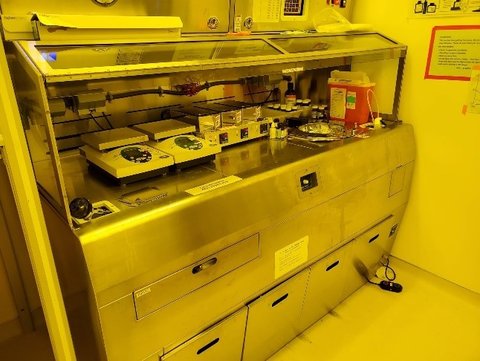
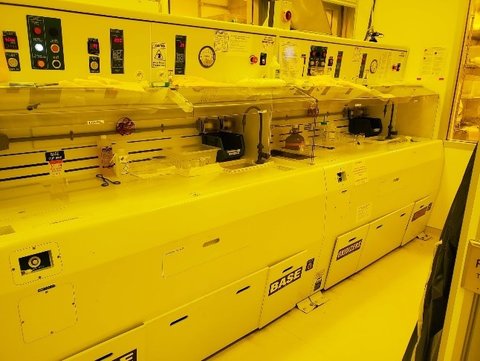
The Nanopatterning Cleanroom has four wet benches each dedicated to specific chemical processing applications. The spinner bench features several hot plates that support e-beam lithography. The solvent bench opposite the spinner bench supports various cleaning and liftoff processes and features a sonicator bath. The base and acid benches are used for chemical processing with alkaline and acidic substances respectively. The Nanopatterning Cleanroom provides users with a variety of general use chemicals, and also supports the use of external, user-supplied chemicals upon staff approval.
There are four groups of hot/cold plates available:
- Torrey Pines HP40A hot plates for general sample heating and resist baking (no chemical beakers) - on a dedicated hot plate tower next to the spinner bench;
- TECA AHP-301CPV cold plate for solvent-based cold development - at the solvent bench;
- Torrey Pines HP40A hot plates for heated Remover PG only - in the fume hood in Spilker 005, adjacent to the wet bench room;
- Torrey Pines HS70 hot plates for corrosive wet chemical heating and stirring - in both the acid and base benches
Contact Information
nano-npc-staff@lists.stanford.edu
Jason Tower, Chris Lung, Heidi O'Halloran, Stanley Lin, Nicoya Reihaneh
Getting Started and Training Information
In order to become a qualified user of the NPC Wet Benches, you need to follow each of these steps in the order as listed here:
- Complete the process to become a lab member of SNSF and follow the instructions to activate a Badger account.
- Complete the process to become a Nanopatterning Cleanroom user.
- Read the following documents:
- Pass (100%) and complete the Wet Bench Safety Quiz and New User Intake Form.
- If you are using TMAH (including MF-319 and MF-312 developers), HF, or piranha, complete the Restricted Chemicals and High-Risk Procedures Prior Approval Form.
- Staff will reach out to schedule in-person training sessions.
- There are two different wet bench trainings, each approximately one hour long. One is for spinner and solvent benches. The other is for corrosive (acid and base) benches. Based on how you responded to the Intake Form, staff will schedule training(s) for your selected benches.
- After completing the training session, you will be qualified to use the wet benches you were trained on.
- More specific wet bench processing training can be requested by emailing staff.
Please note that subsequent training may be required after the initial training depending on what processing you plan on doing. Before you start any new processes after completing the initial training, contact staff at nano-npc-staff@lists.stanford.edu to check if further guidance or training may be required.
Resources
Wet Bench Room Standard Operating Procedures
CEE Apogee Spinner Software Instructions
Hot Plate SOPs
Torrey Pines Hot Plates (HP40A) Standard Operating Procedures
Corrosive Benches Torrey Pines Hot Plates (HS70) Standard Operating Procedures
PROM (PROcess or Materials) Form for New Chemicals
Personal Use Chemical - New Label Request Form
Restricted Chemicals and High-Risk Procedures Prior Approval Form
NPC Safety Data Sheets
Stanford EH&S Chemtracker Safety Database